|
|
|
 |
|
"NOW ABSALOM IN HIS
LIFETIME HAD TAKEN AND SET UP
FOR HIMSELF A PILLAR THAT IS IN THE kING'S valley”
SECOND SAMUEL 18:18
|
|
|
 |
|
 |
| |
Absalom had
a sense of entitlement. But not because he
was the most alluring male in Israel or had
the curliest hair. Of all David’s
sons, he was the only one who had “royal
blood” on both sides. His father ruled
the united kingdom of Israel and Judah,
whereas his mother was the daughter of
Talmai, king of Geshur, north of the Sea of
Galilee.
Absalom, the third eldest son, had a
beautiful sister called Tamar. We can
envision her tall, stately, curved and
luscious like the date palm for which she
was named. She was obviously also very
compassionate. When her half-brother
Amnon, David’s eldest, pretended to be
desperately ill, she baked his favorite
chocolate chip cookies and naively, upon his
demand, delivered them personally to his
bedroom where he seized her and raped her.
Ashamed, she put ashes on her head and tore
her robe in mourning for her lost innocence. |
| |
Coming to
Jerusalem? Tour the Temple
Mount
in the company of Abraham and Isaac, David
and Solomon, Jesus and the disciples, the
angel Gabriel and Mohammed -- and Gila. Meet many
other luminaries, both real and legendary. Now available as a written 24-page
PDF with a
Temple
Mount plan,
guidelines for passing the security check
and ten best reads on the
Temple
Mount from Gila's bookshelves.
|
For the next
two years, her brother Absalom patiently
plotted to avenge his sister’s dishonor.
At a sheep-shearing feast with all the
king’s sons in attendance, Absalom commanded
his servants to slay his half-brother Amnon.
Fleeing from the scene of the crime, Absalom
went north to take refuge in his grandma and
grandpa’s palace located in the city of
Geshur.
After three years, knowing that the king’s
heart pined for Absalom, Joab, David’s
closest advisor, devised a scheme to
convince David to bring Absalom back to
Jerusalem. He summoned a “wise woman”
from Tekoa to plead Absalom’s case before
David. King David relented and sent
Joab to Geshur to return Absalom to
Jerusalem. On strict orders from the
king however, Absalom was barred from the
presence of his dad.
But the fire of resentment churning in
Absalom’s heart could not be squelched.
He lobbied, connived and conspired.
Eventually Absalom succeeded in raising a
rebellion against his father. |
| |
|
COMING TO
JERUSALEM?
BOOK GILA for your customized private tour |
| |
With Absalom
on the outskirts of Jerusalem, David left
his palace, crossed the Kidron Valley and as
he ascended the Mount of Olives barefoot, he
wept. (Second Samuel 15:30)
Absalom triumphantly entered the City of
David. Then the chase began. David
crossed over the River Jordan with Absalom
and his army in hot pursuit. Despite
his precarious situation, David ordered his
generals, “Be gentle with the young man
Absalom for my sake.”
Then Absalom’s thick hair got caught in the
brambly branches of a terebinth tree.
(Unfortunately he was due for his annual
haircut the following week! See Second
Samuel 14:26.) The mule continued
forward which left Absalom hanging between
heaven and earth. Joab plunged three
darts into Absalom’s heart and killed him.
Joab then blew the trumpet to signal David’s
victory and the people returned. They took
Absalom and threw him into a big pit in the
forest and laid a very great heap of stones
over him.
Scripture says next that Absalom, having no
sons, had erected a monument (or pillar) in
the king’s dale and the location was known
to everyone. For two millennia the
king’s dale is believed to be the Kidron
Valley in Jerusalem. |
| |
|
 |
|
Photo:
Gila Yudkin |
|
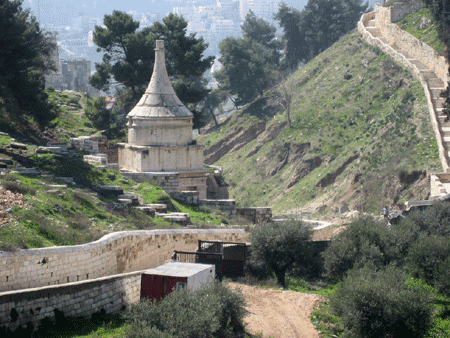
Absalom's Tomb Monument in
the Kidron (King's) Valley |
| |
| First
century AD historian Josephus Flavius
mentions Absalom’s Monument in Antiquities
7, 10, 3. “Now Absalom had erected for
himself a marble pillar in the king's dale,
two furlongs distant from Jerusalem, which
he named Absalom's Hand, saying, that if his
children were killed, his name would remain
by that pillar.” So the whereabouts of
Absalom’s pillar was well-known in Jesus’
day. |
| |
|
 |
|
Photo:
Gila Yudkin |
|
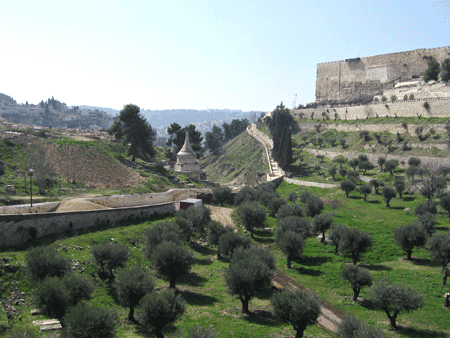
Absalom's Monument (center
of photo) looking south |
|
|
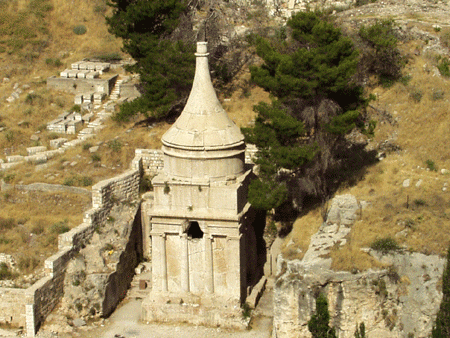
| The tomb
monument which today we call Absalom’s
Monument is, however, dated to one thousand
years after Absalom’s death. It’s an
example of Egyptian-Hellenistic architecture
with the lower part built on a square base
with vaults for burial chambers. The
roof is topped by a concave cone carved in
the shape of a lotus flower with six leaves
partially broken. The monument must
have looked stunning when it was first
carved out of the natural rock in the first
century BC or AD. |
| |
Coming to Jerusalem this
year? Does the hustle and bustle of
the market give you a high, yet you would like some
quiet moments in the holy sites? Are you eager
to eat humus and knafe elbow-to-elbow with
the locals or is dining in the style of King
Solomon and the Queen of Sheba more to your taste?
Would you like to know more about Absalom's
Monument?
Gila's Guide
will lift up your spirit as you "Explore
Jerusalem's Soul." This up-to-date
46-page PDF
guide gives you the Top Ten places to meditate on
the Bible, the Top Ten lesser-known churches worth
visiting, the Top Ten most rewarding roof-top views
and the Top Ten places for sampling yummy Middle Eastern soul
food. More on
Gila's Guide...
|
| Over the
centuries there developed a Jerusalem custom
for fathers to bring their rebellious sons
to Absalom’s Monument to throw stones at the
tomb of the boy who lifted his hand against
his father. Apparently there were so
many “naughty” boys in Jerusalem that by the
beginning of the twentieth century, the base
of the monument to the top of the Ionic
pillars was nearly completely covered with
stones! |
| |
|
 |
|
Photo:
Gila Yudkin |
|
Absalom's Tomb Monument is
sixty feet tall |
| |
| One of my
most leisurely laid-back memorable tours of
2008 was with a group of team members from
the Ramat Rahel Archeological Excavation.
It was a cool early August evening. We
strolled down the Mount of Olives, focusing
upon David’s City and the Temple of Solomon.
Down in the Kidron Valley, I found an old
set of steps that led us up to a point where
we were eye-to-eye with the middle of the
sixty-foot high monument. I had never
brought a group to that particular spot
before. It was the most enchanted
place ever to talk about Absalom. |
| |
| Absalom’s
story has all the elements of a Hollywood
blockbuster: lust, incest, grief, tragedy,
rage, revenge, deceit, blind love, rebellion
and betrayal. But at its root, it’s a
story about a complex relationship between a
father and son. Perhaps the story
grabs our attention because the father is
none other than our beloved David, whose
offspring would produce the messiah. |
| |
| As we sit
beside Absalom’s Tomb, we try to imagine
Jesus walking through the Kidron Valley
after a last supper with his disciples.
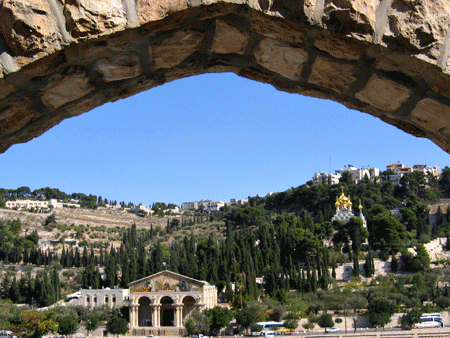
He was on his way to the Garden of
Gethsemane for a night of prayer and
supplication. Absalom’s Monument would
have been glistening in the full moonlight.
It would have been quite new, perhaps only a
few decades old when Jesus passed by.
The tomb monument may have given him an
eerie inkling of what lay ahead. |
| |
|
 |
|
Photo:
Gila Yudkin |
|
The Garden of Gethsemane,
only a short distance from Absalom's
Monument |
| |
| |
|
Gila Yudkin,
who calls herself a Connecticut-born Yankee
living now in King David's court, has been
shepherding pilgrims in the Holy Land for
over a quarter of a century. She
hasn’t yet lost one stray – at least not
permanently! If you are interested in
off-the-beaten path experiences that provoke
discussion and illuminate the biblical
narrative, check Gila’s availability before
booking your tour. Your participants
will be effusive in their thanks. |
| |
|
More on
Biblical Archeology |
| |
|
 |
 |
 |
|
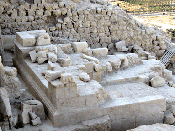
Herod's tomb at Herodion |
Priestly blessing |
Solomon's dowry:
Gezer |
| |
|
|
|
 |
 |
 |
|
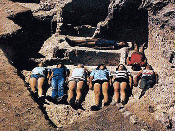
Joshua burning Hazor |
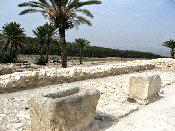
Solomon's stables: Megiddo |
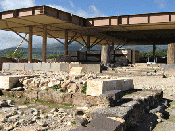
Saul's body at Beth Shean |
| |
|
|
|
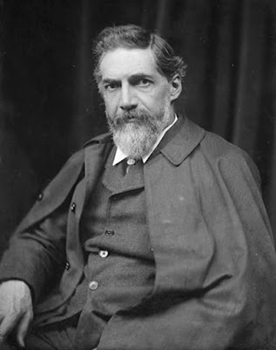
Not too far away from Absalom's Monument, the nineteenth and twentieth century
Holy Land explorer and preeminent
archeologist
Sir Flinders Petrie
was buried headless in the Protestant
Cemetery on Mount Zion in Jerusalem.
Read about why he is important and why
he is headless! |
| |
 |
 |
|
Photo: Gila
Yudkin |
Courtesy of Wikipedia
Commons |
|
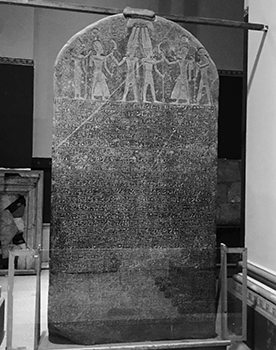
Merneptah or Israel
Stele |
Archeologist Sir
Flinders Petrie |
| |
|
If you know someone who’s looking to be
inspired to slay giants as Absalom’s dad
did, check out the “traditional
slingshot that killed Goliath.” |
| |
|
If you're interested in holy land heroines,
then read about the bathing beauty
Bathsheba, Absalom's step-mother. |
| |
|
Copyright 2009, 2016 Gila Yudkin. Permission
needed for any reuse. |
|
|
|
GILA
YUDKIN
•
TCHERNIKOVSKI
64A
•
JERUSALEM
•
ISRAEL
gila@itsgila.com
HOME
•
BOOK
GILA
•
TIPS
FOR TOURS •
ABOUT GILA
|
|
