|
|
|
 |
|
"Now the Philistines gathered
their armies for battle;
they were gathered at Socoh, which belongs to Judah,
and encamped between Socoh and Azekah, in Ephes-dammim"
First Samuel
17: 1
|
|
|
 |
|
 |
|
In three full decades of guiding, I have
only once led a group up to Tel Azekah and I’m
inviting you to be next.
Only 50 minutes (by bus) from Jerusalem, Azekah figures in the stories of four
biblical heroes (David and Hezekiah, Joshua
and Jeremiah) and one villain (Goliath).
David: When David brought cheeses,
baguettes and trail mix from Bethlehem to
his brothers serving in Saul’s army, he must
have been struck by the sight of Azekah, a
tall mound, towering about 1200 feet above
sea level as he looked west. Azekah
guarded the northwest pass into the Elah
Valley and served as the western-most camp
of the Philistines with a bird’s eye view
over the valley of Elah. |
|
|
|
|
Photo:
Gila Yudkin |
|
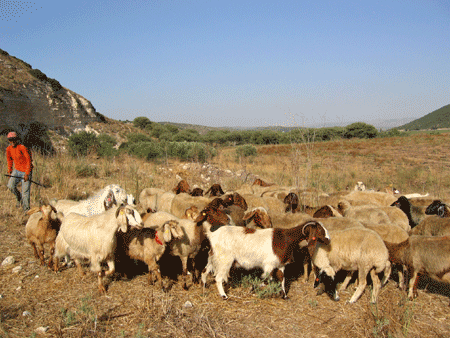
Shepherd and goats by the
riverbed of the Elah Valley below Azekah |
|
|
Goliath: Sentries at Azekah would
have cheered as they watched Goliath from
Gath strut by to challenge the Israelites.
His armor included a bronze helmet, a coat
of mail weighing thousands of shekels,
bronze greaves and a javelin. But Goliath
was no match for David, the Lord’s anointed,
who triumphed with a sling and a stone.
Once the Philistines saw that their champion
was dead, they stampeded in panic, past
Azekah to their strongholds in Gath and Ekron. |
|
|
 |
|
Copyright
2012 by Gila Yudkin |
|
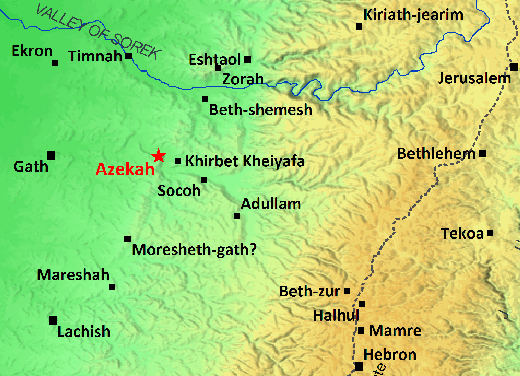
Map of the Shephelah with
Azekah overlooking the Elah Valley |
|
|
Hezekiah: Three hundred years after
David established his kingdom, Judean King
Hezekiah (of “Hezekiah’s Tunnel”) found
himself facing a ferocious enemy from the
north – the Assyrians. Hezekiah is
mentioned in an inscription on two tablets
found in Nineveh (northern Iraq) where the
Assyrian king (either Sargon II or
Sennacherib) bragged that he had captured
the stronghold of Azekah: |
|
“With the power and might of Ashur, my
lord, I overwhelmed the district of
Hezekiah of Judah...Azekah, his
stronghold, which is located between my
land and the land of Judah...I besieged by
means of beaten earth ramps, by great
battering rams brought near its walls, and
with the attack of foot soldiers...I
captured this stronghold, I carried off
its spoil, I destroyed, I devastated, I
burned with fire.”
|
|
Hezekiah’s stronghold, Azekah, is described
as a stronghold in the midst of the
mountains, located on a ridge like a pointed
dagger. It was much like an eagle’s
nest and was inaccessible, even for siege
ramps and battering rams. Apparently,
though, Azekah was ruthlessly destroyed,
right before the king of Assyria continued
onwards to besiege Jerusalem, Judea’s
capital. |
|
|
|
 |
|
Photo:
Gila Yudkin |
|
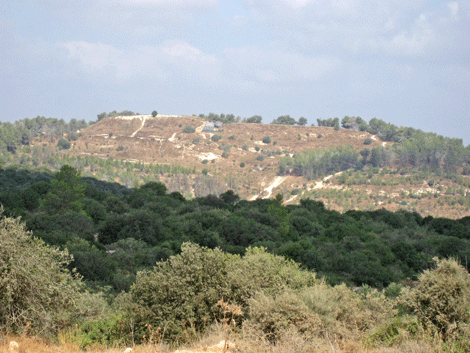
View of Tel Azekah from
Khirbet Kheiyafa (Shaarayim?) |
|
Despite its important biblical connections,
Tel Azekah hadn’t been touched by the
archeologist’s spade for over one hundred
years. During the course of four
months,
in 1898 and 1899, American Frederick
Jones Bliss and Irish Robert Alexander
Stewart Macalister excavated at Azekah.
They discovered remains of an Israelite
fortress which had guarded the trade route
to Egypt with evidence of numerous small
finds like scarabs, beads, and pottery.
This was during a period of Ottoman rule
when the Turkish authorities became aware of
the ardent archeological appetites of the
European countries which stimulated in turn,
a thriving market for antiquities in
Jerusalem. Foreign archeologists were
looked at as an “economic opportunity” and
the Ottoman “commissioner” or supervisor was
determined to receive his fair share.
Perhaps the constant official pressure for
bribes exacerbated the personality clashes
between Bliss and Macalister. |
|
|
 |
|
Photo:
Gila Yudkin |
|
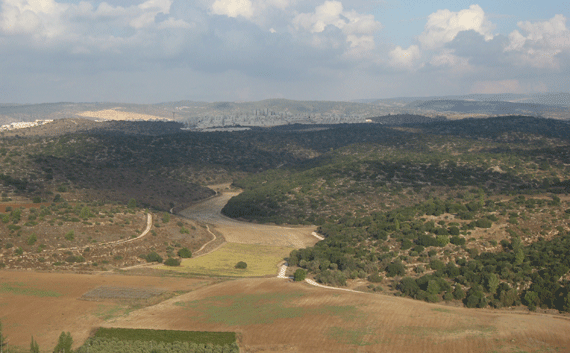
View from Tel Azekah
towards
the east |
|
|
The upshot is that Tel Azekah has been “terra
incognita” in terms of Iron Age archeology –
one of the few biblical mounds left to be
explored. If we take the Azekah
inscription concerning the 8th c BC Assyrian
assault and devastation at face value,
imagine how much ash and destruction (and
inscriptions?) there are yet to be
discovered. |
|
|
The team I
was associated with for five years at Tel Ramat Rahel in
Jerusalem began excavating at Tel Azekah in the summer of 2012. Before
the dig even began,
a number of Tel
Aviv University graduate students focused on various aspects of surveying the tel
while studying the Macalister reports at
the Palestine Exploration Fund headquarters
in London. |
|
|
 |
|
Courtesy of
Professor Oded Lipschits |
|
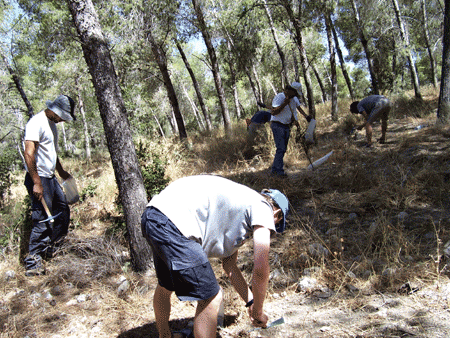
Professor Lipschits' team
surveying Azekah in 2009 |
|
|
 |
|
Courtesy of
Professor Oded Lipschits |
|
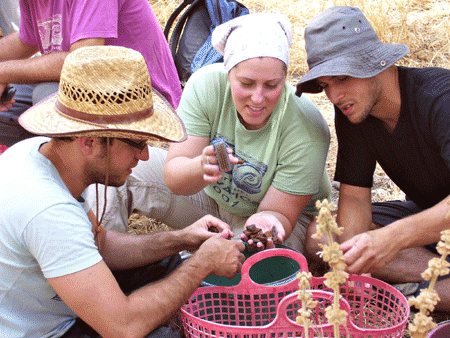
Tel Azekah
excavators
studying pottery collected in a pre-dig survey |
|
|
 |
|
Photo:
Gila Yudkin |
|
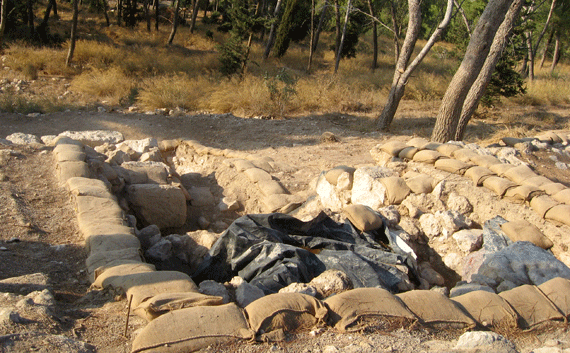
Excavation pit on the
summit of Tel Azekah after the 2015 season |
|
It’s at an authentic site like Azekah where
the Bible comes to life in vivid color.
Today there’s an access road and stone steps
up to the summit of the tel. Come
visit while it’s still terra incognita and
let’s allow our imaginations to roam around
the stories of David, Goliath, and Hezekiah.
And then, we’ll tackle Joshua and Jeremiah
as well! |
|
|
|
 |
|
Photo:
Gila Yudkin |
|
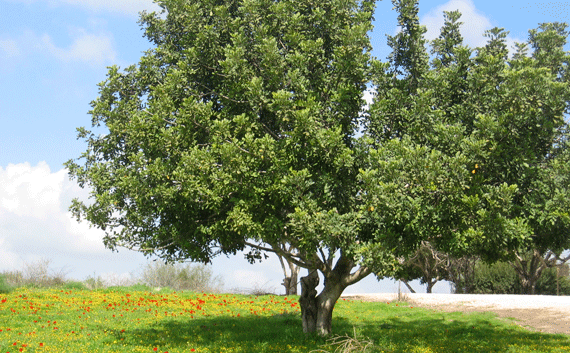
Wildflowers and elah
(terebinth) tree in the Elah valley below Azekah |
|
|
| |
|
Gila Yudkin,
who calls herself a Connecticut-born Yankee
living now in King David's court, has been
shepherding pilgrims in the Holy Land for
nearly thirty years. Until August
2009, Gila Yudkin hadn’t visited Azekah
since 1988 when she belly-crawled with her
good buddy and mentor Steve Langfur through
eight chambers of a cave used by Bar Kochba
fighters in the second century AD.
This was before she realized that she had
claustrophobia!
21 years later, she discovered that
Azekah has a paved road, a parking lot,
stone steps to the summit and even benches
to overlook the Biblical battlefield.
A visit is relatively easy, highly
recommended and it includes no crawling! |
| |
|
Copyright 2010, 2016 Gila Yudkin. Permission
needed for any reuse. |
| |
| More on
David and his sons: |
| |
 |
 |
 |
|
David / Temple Mount |
Absalom / Bethsaida |
David / Cave of
Adullam |
|
|
|
|
 |
 |
 |
|
Megiddo / Solomon's stables |
Absalom's Tomb |
Jerusalem / Solomon's digs |
|
|
|
GILA
YUDKIN
•
TCHERNIKOVSKI
64A
•
JERUSALEM
•
ISRAEL
gila@itsgila.com
HOME
•
BOOK
GILA •
TIPS
FOR TOURS •
ABOUT GILA
|
|
