|
|
|
 |
|
“A
VOICE IS CRYING OUT IN THE WILDERNESS
PREPARE THE WAY FOR THE LORD"
ISAIAH 40:3
|
|

|
 |
| |
The
drama of the discovery of the Dead Sea Scrolls has
intrigued the world since 1947. Here’s an A to Z
introduction to the discovery, study and
significance of the scrolls:
Albright,
William F. was considered the
foremost archeologist and Bible scholar of his
generation. He was an American who taught at
Johns Hopkins University. When he was shown a
photocopy of the first manuscripts bought from the
antiquities dealer by the head of Jerusalem’s Syrian
Orthodox church, he exclaimed, “This is the most
important discovery of the 20th century!”
Beduin
from the Tam’ra tribe were the first to discover the
scrolls when a young boy named Mohammed ed-Dib threw
a stone inside a cave to find a lost goat. He heard
the clink of pottery and thought he had discovered
gold. Was he ever disappointed – at least in the
beginning!
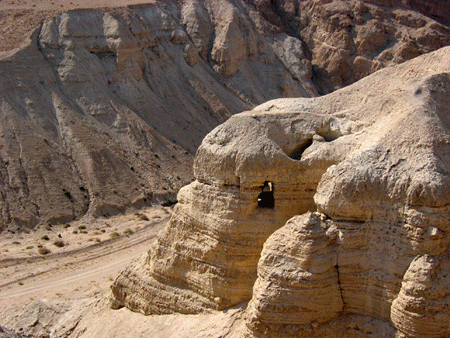
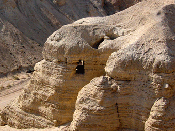
CAVE
NUMBER 4
can be seen from the Qumran
plateau. Altogether more than 550 fragments
out of 850+ larger fragments of the scrolls were
found in Cave #4. These fragments included
parts of every book of the Old Testament except for
the Book of Nehemiah and the Book of Esther.
|
|
 |
|
Photo: Gila
Yudkin |
|
Cave # 4 excavated by Roland de
Vaux in the 1950s |
| |
Dead
Sea Scrolls were written on
parchment, that is animal hides. According to
DNA studies, the hides were from goats, sheep and
ibex (which are plentiful in the area of Ein Gedi).
Essenes
were members of the community who inhabited
Qumran,
according to most scholars. The Essenes were
an ascetic group who were protesting against the
practices of the priestly leadership in the Temple
in Jerusalem. They came down to the wilderness
to await the coming of the messianic age.
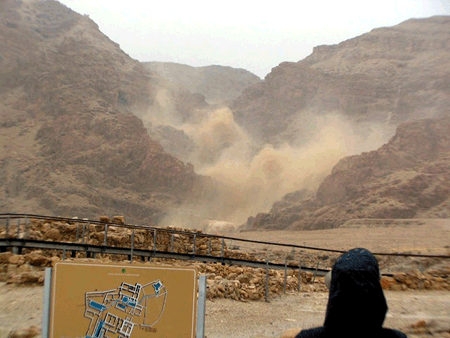
Flash
Floods are common in the Qumran
area when it pours in Jerusalem. At Qumran
itself there are usually 360 sunny days a year.
|
|
 |
|
Photo:
Courtesy of David Schlaegel |
|
Extraordinary flash flood at Qumran,
April 2006 |
| |
Gospel
of Matthew places the
ministry of
John the Baptist by the River Jordan in the land of
Judea, in close proximity to the scribes who were
copying the scrolls at Qumran. Thus the
scrolls have engaged the attention of Christians
since their discovery in 1947.
Hidden
in Clay Jars, the scrolls survived for
2,000 years. Whatever wasn’t hidden in jars was
taken by the birds. Many bird nests in the
Judean wilderness have been found with bits of the
old scrolls tucked into them.
|
|
 |
|
Photo: Gila
Yudkin |
|
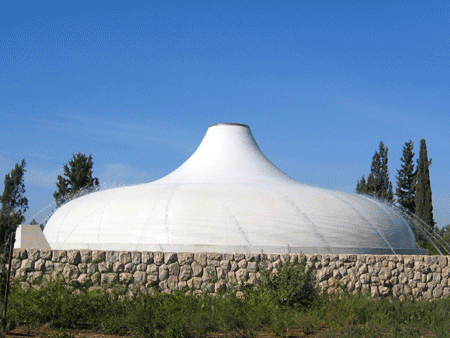
Shrine of the Book which exhibits
part of the Isaiah Scroll |
| |
Isaiah
Manuscript 1 is the most important
scroll found until now. It is complete – with all 66
chapters of the Book of Isaiah. Isaiah
Manuscript 1 is at least 2,100 years old. It is
nearly identical to the Isaiah text from which the
Bible has been translated into a multitude of
tongues. The scribes over the centuries
diligently and accurately copied the sacred text!
A section of the
Isaiah Manuscript 1 can be viewed
at the Shrine of the Book in Jerusalem.
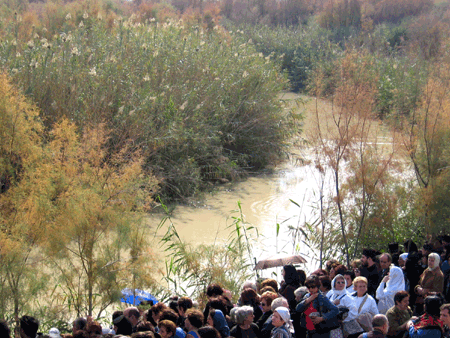
John
the Baptist was baptizing in the
River Jordan only 5 miles as the crow flies from the
Essene settlement. He was telling people to
repent, for the kingdom of heaven was close at hand.
(Matthew 3:2) For 50 years Dead Sea Scroll
scholars have been debating whether there is a
connection between John the Baptist and the Essene
settlement.
|
|
 |
|
Photo: Gila
Yudkin |
|
Pilgrims by the River Jordan
celebrating the Epiphany |
| |
Kando
was the nickname of the most astute antiquities
dealer. He sold the first 4 Dead Sea Scrolls
to the head of his church for a mere $97.20.
The head of the Syrian Orthodox church later sold
those four scrolls to Yigael Yadin for $250,000!
Light
versus darkness was one of the Essene themes.
They believed that they, the Sons of Light, would
eventually triumph over the Sons of Darkness.
Mar
Athanasius Samuel, the
Metropolitan (bishop) of the Syrian Orthodox Church,
bought the first scrolls although he did not know
their true antiquity. The liturgy of his
church is Aramaic, the spoken language of Jesus day,
and he thought the scrolls may be biblical in
content.
Nails
once attached to 2,000-year-old
sandals were discovered on the paths between Qumran
and the caves, proving that people from Qumran were
hiding the scrolls. The nails can be seen at
the Shrine of the Book in Jerusalem.
Olive
oil lamps produced carbon soot
which was mixed with honey, oil, vinegar and water
to thin the ink to the proper consistency.
Pliny,
a first century A.D. Roman historian, wrote, “On the
west side of the Dead Sea is the solitary tribe of
the Essenes, which is remarkable beyond all the
other tribes in the whole world, as it has no women
and has renounced all sexual desire, has no money,
and has only palm trees for company.”
Qumran
is the name of the plateau opposite the caves where
the scrolls were found. Qumran in Arabic means “two
moons.” At the time of the full moon, one moon
can be seen in the sky, and a second moon is
reflected in the water of the Dead Sea. Qumran is
almost always on my pilgrimage itineraries..
Ritual
Baths were found in abundance at
Qumran. The Jews at Qumran immersed themselves
so as to be in a state of purity before eating their
main communal meal.
|
|
 |
|
Courtesy of the
Israel Antiquities Authority |
|
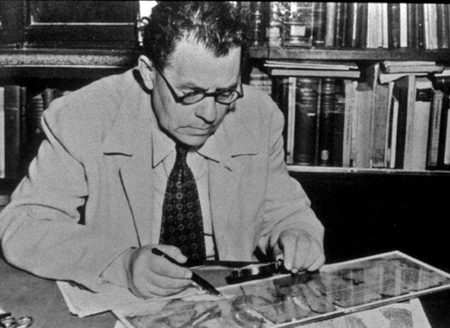
Professor Eleazar Sukenik studying
the Thanksgiving Scroll |
| |
Sukenik,
Eleazar boarded a bus bound for
Bethlehem on November 29, 1947 in order to inspect
the scrolls in the attic of the antiquities dealer.
Sukenik was the first to realize that the scrolls
were genuinely over 2,000 years old.
The
Temple Scroll was “discovered” in a
shoebox under a floor tile in Kando’s bedroom in
1967. The 30-foot long Temple Scroll is a
rearrangement of biblical laws with God speaking
almost continually in the first person.
Unaware
of the True Value of the leathers,
the Beduin approached a cobbler in Bethlehem and
asked that he turn them into sandals. Luckily the
cobbler noticed writing on the leathers and realized
they were ancient manuscripts!
Vaux,
Roland de was the chief excavator
at Qumran in the 1950s. He believed that Qumran was
like a monastery. Since the residential area wasn’t
large, de Vaux concluded that most of the sect
members lived in the surrounding caves and came to
the Qumran center to dine and serve God.
|
|
 |
|
Photo: Gila
Yudkin |
|
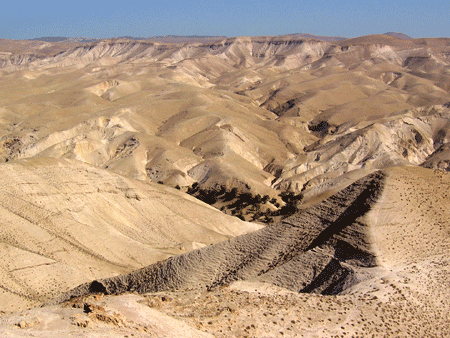
Wilderness of Judea |
| |
Wilderness
of Judea was a magnet for Jews
waiting for the messiah to appear. They quoted
Isaiah 40:3, “A voice is crying in the wilderness,
prepare the way for the Lord.”
X-tra
Biblical Literature was found in
addition to the biblical texts. For example,
the Thanksgiving Scroll is a collection of
psalm-styled poems.
Yigael
Yadin was shown an ad in the Wall
Street Journal which advertised the sale of 4
biblical manuscripts. He guessed that these
were scrolls similar in age to the ones his father,
Eleazar Sukenik, had bought in 1947. Yadin
bought the four scrolls for Israel for the tidy sum
of $250,000.
Zealots
fighting at Masada must have included some Essenes
from Qumran for a special solar calendar with 5
Sabbaths in each month was discovered at both Qumran
and Masada.
|
|
On your
next pilgrimage, come with me to visit
The Shrine of the Book, the Judean Wilderness and
Qumran! |
| |
|
Copyright 2007,
2011
Gila Yudkin. Permission needed to reprint in
any medium. |
| |
|
|
More on the Dead Sea Scrolls |
|
|
 |
 |
 |
|
Scroll of Isaiah |
Discovery of the
Scrolls |
Qumran |
| |
|
|
|
|
|
|
GILA
YUDKIN
•
TCHERNIKOVSKI
64A
•
JERUSALEM
•
ISRAEL
gila@itsgila.com
HOME
•
HOLY
LAND
HEROINES
•
SONGS
& PRAISE •
ABOUT GILA
|
|
