|
|
|
 |
|
"WHEN
THE LORD BROUGHT BACK THOSE THAT RETURNED TO ZION,
WE WERE LIKE THOSE WHO DREAM"
PSALM 126:1
|
|
| |
|
 |
|
- What was it like
going back to work after a two-year shut-down
due to the covid pandemic?
|
|
Exhilarating!! My first tour, in January 2022,
was for me as adventuresome and challenging as
traveling solo abroad. I never knew what would
happen from one minute to the next. Which site
would be open, which would be closed; whether any
site would be crowded. (None were!) My group
of 28 participants from Ohio was the largest group
of pilgrims in the country at that time. By
far! |
|
|
 |
 |
|
Photo: Julie Wise on tour with Gila
Jan '22 |
Photo: Jim Love on tour with Gila Jan
'22 |
|
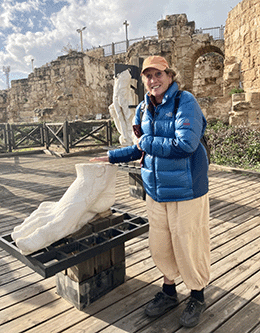
Gila outside the Caesarea theater
guiding her first group after a two-year break |
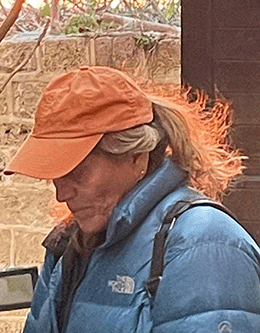
Gila reading the Bible by the
House of Simon the Tanner as the sun is setting |
|
|
We were greeted with astonishment and glee by the
locals We were the only group up on the Temple
Mount. The only group visiting the tomb at the
Holy Sepulcher church where my 2019 groups had spent
one to two hours waiting in line. At the
Church of the Nativity in Bethlehem I was able to
speak in the grotto, for the first time in more than
three decades. We had the church in Shepherds
Fields all to ourselves and sang not one, but three
Christmas carols, enjoying the resounding echoes. |
|
|
My tour leader, Dr. Jim Colledge, his fifth time
with me, was able to teach as much as he wanted
wherever he desired without any interference.
There was no rush. No jostling. With
plenty of time for silent prayer and contemplation.
It was simply a thrilling holy land experience! |
|
- Why did you become a
guide?
|
The
first couple of years after I came to Israel from
Connecticut, I taught English in a kibbutz school in
the Beit Shean Valley. During school vacations I
would go to the Sinai on 8-day trips organized by
the Society for the Protection of Nature in Israel.
Every trip we would climb a different mountain
reputed to be “the” Mount Sinai from which Moses
descended with the Ten Commandments. One trip was
particularly memorable – we walked for three days
straight, with camels carrying our food and sleeping
bags.
I fell in love with the Sinai – with its
umbrella-shaped acacia trees and sudden oases, the
Beduin with their vibrant folklore, the ragged
granite mountains and so many theories about where
the Israelites actually did their 40-year wandering.
Enthralled by all the stories and adventure, I fell
in love with every guide I ever had – and I wanted
to be just like them. So I applied to become a guide
myself.
|
|
 |
|
Photo:
Peter Giordano on tour with Gila in the 1990s |
|
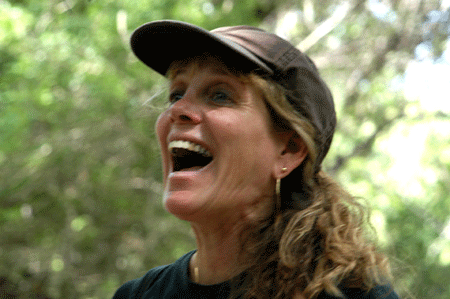
It's Gila on tour |
|
Ironically, exactly one month after I began the
guide course, Anwar Sadat, President of Egypt,
unexpectedly came to address the Israeli Knesset
(Parliament), which set in motion the Israeli
withdrawal from Sinai. Despite three
decades of guiding experience throughout Israel, I
have never guided the Sinai!
But during the guide course, I discovered the rest
of the country. South of Bethlehem we swam through a
grotto of springs channeled by Herod the Great to
the Temple Mount in Jerusalem. By Mount Sodom, on
the shores of the Dead Sea, we crawled through a
flour cave in total darkness. In the Galilee, we
climbed down the face of the Arbel cliff before
there were ropes to hold on to (that was scary!) and
we hiked every major dry river canyon between Dan
and Beersheba.
|
- What is your favorite
site today?
|
| Without
a doubt --
Tel Dan, in northern Israel. Guiding
biblical sites is today my passion. And there are so
many biblical passages that can be discussed and
illustrated at Dan. As we walk along the roaring Dan
springs, we make a detour to reach the altar to the
Golden Calf, King Jereboam’s religious shrine
established to rival Solomon’s Temple in Jerusalem.
The archeologist Abraham Biran was amazed when he
realized that this altar – to the golden calf we
think – was built with three layers of dressed stone
followed by a layer of cedar wood, apparently to
cushion against earthquakes – exactly the
description of the building of Solomon’s Temple in
First Kings 7.
|
|
|
As we sit on the 8th century BC steps leading to the
high altar and ponder the First Kings chapter 12 story,
discussion inevitably leads to the issue of whether we
have embraced the worship of modern-day idols in our own
lives. |
|
|
|
 |
|
Photo: A.
Pilgrim |
|
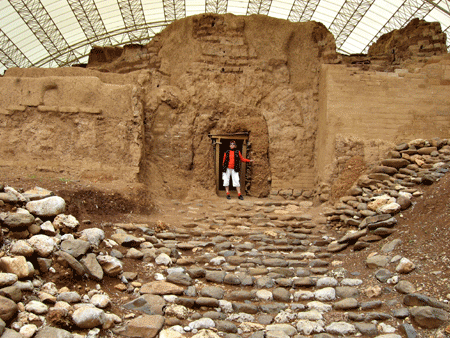
It's Gila in front of Dan's 18th
century BC mud-brick gate |
|
|
|
By the triple-arched 18th century BC mud-brick gate, we
read about Abram’s chase after his nephew Lot, the
world’s first recorded hostage. Archeologist
Abraham Biran has said that he imagined the king of
Dan (or Laish as it was called by the Canaanites)
stepping right out of this gate to greet Abraham!
And at the 9th century BC city gate complete with the king’s
“throne-seat” we recall how David mourned his rebellious son
Absalom, until he took his “seat by the city gate.” And
there are a lot more Bible stories connected to Dan! |
|
|
| |
- Who’s your
favorite Bible character?
|
David, the shepherd, musician, warrior,
outlaw, and king! I once planned and
guided a tour in the Footsteps of David.
Was it ever great. Original, too.
We sat below Gath, Goliath’s home town, and
talked about David burying his sword before
going into the city, pretending to be
insane. It could have been right below
the picnic benches where we were sitting.
That was a thrilling thought.
It’s great fun to reenact “David versus
Goliath” in the Valley of Elah, where the
battle actually took place. I narrate
the story from First Samuel 17 while the
biggest fellow in our group plays Goliath
and a small redhead or a kid with freckles
plays David the Bethlehemite. I even
bring a
slingshot along which “David”
gets to take home as a souvenir. |
| |
- What was your
first dangerous dilemma as a guide?
|
|
It happened on July 26.1983 while I was
guiding a group of students at Sebaste/Samaria.
It will be a chapter in my upcoming book,
Holy Land Haunts: Forty Years of
Guiding Adventures. Read the
chapter
Spooked in Sebaste. |
| |
- What’s your
favorite site in Jerusalem?
|
|
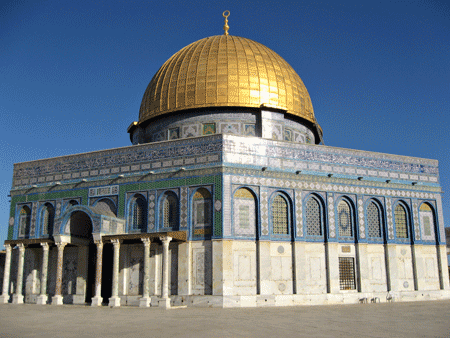
The Temple Mount! I love imagining
David, Solomon, Jesus, the money-changers,
Abraham, Isaac, and even Mohammed and his
whimsical horse, all on the Temple Mount.
Not all at the same time, though! The
spaciousness of the huge Temple Mount
courtyard and the symmetry of the Dome of
the Rock topped by all that dazzling gold
provoke my photographer's eye. I truly
believe that the Temple Mount lies at the
center of the universe and thus charged with
emotion for people of all faiths. The
most challenging tours of my entire career
have been when I have taken inter-faith
groups of Jewish, Christian and Muslim
clergy up on the Temple Mount. |
| |
|
I have just released a one-hour
audio tour where I
recorded my favorite stories about all the
real and legendary characters connected to
this magnificent site. |
| |
|
 |
|
Photo:
Gila Yudkin |
|
I love to visit and
photograph Mount Moriah / the Temple Mount |
| |
- What was the
biggest surprise you arranged for a group?
|
|
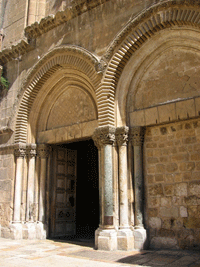 |
By pulling
many strings, I once managed to arrange a
7:00 a.m. mass in the Church of the Holy
Sepulcher for a group of 99 American
pilgrims, of which I was chief guide.
It was difficult, for there is a very
strictly enforced “Status Quo” agreement of
several centuries which dictates which
denominations can celebrate mass at what
hours in which chapels.
My group of 99 pilgrims had the
extraordinary privilege of celebrating mass
just outside the Tomb itself. Unexpectedly,
as the mass ended, the organist, whom I had
been schmoozing with earlier, burst into a
glorious rendition of the “Star Spangled
Banner.” There wasn’t a dry eye |
|
Photo:
Gila Yudkin |
by the Tomb.
Afterwards, every single |
|
Entrance, Church of the
Holy Sepulcher |
member of the
tour hugged me for that |
| |
highlight.
|
| |
|
Coming to Jerusalem
soon? Are you coming from very
far away and want every minute to matter?
Would you like to experience both the authentic
and the traditional sites, yet you are most
interested in finding the venues where you can
quietly be transported back in your imagination to
the time of Jesus? David? Abraham?
"Explore
Jerusalem's Soul" with
Gila's Unorthodox Guide
comes to via email as a PDF (Adobe Acrobat) 46-page guide
giving you the top ten places to meditate on the
Bible, visit lesser known churches, get a roof-top
view and sample Middle Eastern
food. More...
|
- What was your
most embarrassing moment on tour?
|
Tripping over a knee-high pillar in the
courtyard of the church commemorating the
Feeding of the 5,000, I fell on my face in
front of 50 Malaysian pilgrims. Whoa –
that was a humbling experience. My
nose was broken in three places and I
required 17 stitches on my face.
But, after only five days, when the cast was
taken off, I greeted my next tour at the
airport, shiners and all. The group
joked that I looked like a cat with
whiskers, for some of the stitches were
sticking out above my upper lip. It
was hard for me to sing, and that was one of
the few tours that I waited till the very
end to teach “Hava
Nagila,” my groups’ favorite Israeli
folksong. |
| |
- What was your
most difficult tour?
|
When Yitzhak Rabin was assassinated, I was
with a group in the Galilee. I had
gone to bed early and was only half
listening to the TV, while I was getting
dressed the next morning. When I heard
that the prime minister was dead, I screamed
and dropped on the bed in disbelief.
That day was so hard – I insisted on
carrying out our planned itinerary, but my
tour leader, Dr. Randall Lolley, senior
pastor at the First Baptist Church in
Greensboro, North Carolina, asked that we
stop somewhere along the way to watch the
funeral broadcast. So I called a
kibbutz and asked permission for our group
of 44 pilgrims to stop by their clubroom,
where they had a TV and a large enough space
for everyone to sit.
Dr. Lolley asked that we watch it in the
Hebrew original, (not the CNN translation)
so that we all would “experience” the
funeral. We were with kibbutz members,
and I stood to translate for the group.
When Rabin’s granddaughter Noa gave her
eulogy, it was so beautiful that I broke
down in the middle of her speech.
We arrived in Jerusalem the following
afternoon and after depositing the group in
their hotel, the Palestinian driver and I
bought a wreath at a florist shop in East
Jerusalem. The next day we all visited
Yitzhak Rabin’s grave on Mount Herzl.
Two years later to the day, I sent Dr.
Lolley a postcard, saying that I had just
visited the grave. Here’s what he wrote me
in response, |
| |
"Thanks for thinking of us as you
visited Mr. Rabin's grave site on the
second anniversary of his death. We
will NEVER forget your poise, pain, and
confidence in the peace process which
shined through your grief. We all
mourn his death and hope every day that
the principles for which he worked (and
even died) will prevail.”
|
|
 |
| |
|
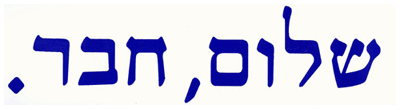
Above, a bumper sticker in Hebrew which
reads, “Shalom Haver,” meaning “Goodbye, my
friend.” President Bill Clinton
concluded his eulogy for Prime Minister
Rabin with these
Hebrew words which touched the heart of
every Israeli. Soon afterwards a
majority of cars in Israel displayed the
sticker. I sent one to Dr. Lolley, and
he put it on his car and drove around
Greensboro, North Carolina. |
| |
- Can you give
us an example of a historical tale you
relish telling on the bus?
|
Anyone who has been on my bus knows my
favorite story --
Cleopatra.
I find her absolutely fascinating.
Cleopatra’s contemporaries claim her allure
was in her charm, not her beauty. In
fact, there’s a coin with her portrait on it
in the British Museum which shows her with a
beak nose! One historian says the
essence of her nature was a “combination of
female charm and a masculine brain, both
bent on the pursuit of power.”
Her story is connected to a number of sites
on our pilgrimage route – Caesarea, Masada,
Ein Gedi, and Jericho. She delighted
in exotic perfume, especially balsam grown
in Jericho and Ein Gedi. On her
birthday, Mark Antony surprised her with the
deed to the balsam plantations. Herod
the Great was definitely not a happy camper
when he heard about this!
|
|
 |
|
Photo: A.
Pilgrim |
|
Entrance to Masada from
the Snake Path |
| |
In the guardroom at the entrance to Masada,
above, I’m telling the group why
Herod went to all the trouble to build this
fort in the Judean Wilderness.Remember
that this is the same Herod, mentioned in
the gospel of Matthew, as responsible for
the death of the infants in Bethlehem.
He, of all people, was so afraid of
Cleopatra that he built the fortress of
Masada as a refuge in case she ever
succeeded in fomenting a rebellion against
his rule. |
| |
- Who's your
favorite holy land humorist?
|
|
Mark Twain!! His dispatches to New
York and San Francisco newspapers
chronicling his European and Holy Land
misadventures are hilarious. Many of
them poked fun at his fellow travelers, the
hapless locals and particularly his
loquacious guides who never shut up! I
had a blast writing a tongue and cheek
Mark Twain's
Tips for Holy Land Pilgrims.
Very recently while researching a
highlight on the witch of En Dor, I
discovered that Mark Twain had actually
visited En Dor and had haggled with a Beduin
over what he calls a curious, ancient pipe
which was supposedly smoked by the sorceress
at the séance with Saul! The village
of En Dor has subsequently disappeared, as
have all other relics belonging to the
infamous witch. |
| |
- What new
species did you introduce to the landscape
of the Holy City?
|
|
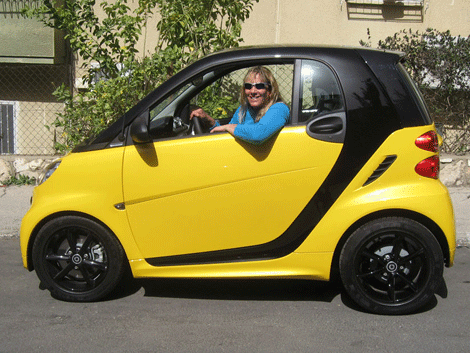
I was the first to bring a Smart Passion
city flame to Jerusalem. Her name is
Bumble (as in bee). In Hebrew we call
her d'vorah. |
| |
|
 |
|
Photo:
Barbara Kreiger |
|
Gila driving Jerusalem's
first Smart Passion City Flame! |
| |
- What’s your
favorite music?
|
|
Blues and gospel. I love singing
spirituals on bus rides. I surprise my
groups with funny stanzas they have never
heard for “Go Down Moses” or “Down by the
Riverside.” I connect songs with
places they didn’t know the songs were
about. Everyone knows “Joshua Fit the
Battle” goes with Jericho, but do they know
“Swing Low Sweet Chariot” is also connected
to Jericho? I even teach
Hebrew songs,
and we establish a repertoire of Israeli
hits. |
| |
- What’s the
most unusual praise you ever received?
|
|
This took place in a period when groups were
being pestered by hawkers and pickpockets.
The thieves knew that if they stole from
anyone in my group, I would report them.
(Wallets picked out of pockets of my
pilgrims were nearly always returned.)
A big, husky guy on tour with me told the
group, “If I were President of the United
States, I would want Gila to be my
BODYGUARD!” |
| |
|
|
|
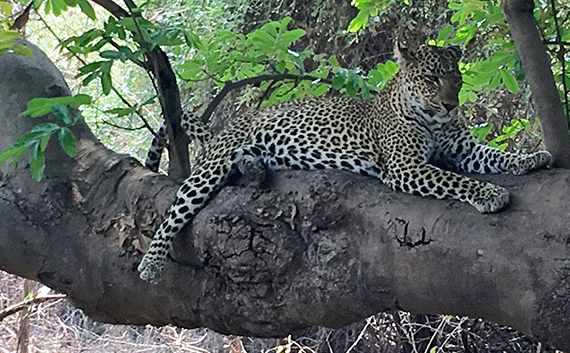
Travel and more travel. Especially
safaris. I love observing the drama
between the animals in the bush. My first safari was in 1995
-- to Kenya -- where I hoped to see a
leopard. Nope. FINALLY in Zambia
in October 2021. |
| |
|
 |
|
Photo:
Gila Yudkin |
|
Finally but finally
spotted a leopard in 2021, but not in En
Gedi! In Zambia |
| |
| When I first started
to guide there were actually leopards
roaming the Judean Desert in the area of En
Gedi. We were forbidden to hike with
less than eight people. But I never
saw one. It's my wish that leopards
would return to the holy land, to the area
where David once tended his father's flocks
of sheep. |
| |
- What’s your
hope for Jerusalem?
|
|
 |
|
Photo:
Gila Yudkin |
|
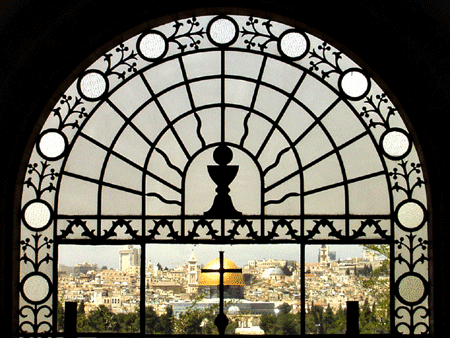
View of Jerusalem as seen
from Dominus Flevit
on the Mount of Olives |
| |
|
That Zechariah’s prophecy (chapter 14)
promising the eternal security of Jerusalem
will be fulfilled in my day. And I
wonder where I’ll be and with which group
when the following comes to pass: “On that
day His feet shall stand on the Mount of
Olives, which lies before Jerusalem on the
east; and the Mount of Olives shall be split
in two from east to west by a very wide
valley; so that one half of the Mount shall
withdraw northward, and the other half
southward.”
|
|
|
|
Are you considering
leading a tour to the Holy
Land? Everything you would
want to know -- from A to Z so your tour
will be a rave success! |
|
|
Read what Tour
Leaders say about Gila.
|
|
|
|
Gila's pilgrims often joke that they are on
safari with Gila as she shows them herds of
seemingly wild camels,
families of ibex from grandpa
with
ferocious horns to
babies taking their first steps to
sun-bathing rock rabbits (or conies) by the
shores of the Sea of Galilee or on the
cliffs of Caesarea Philippi.
|
|
|
|
GILA
YUDKIN
•
TCHERNIKOVSKI
64A
•
JERUSALEM
•
ISRAEL
gila@itsgila.com
HOME
•
BOOK
GILA
•
HOLY LAND HEADLINERS •
TIPS FOR TOURS
|
|
